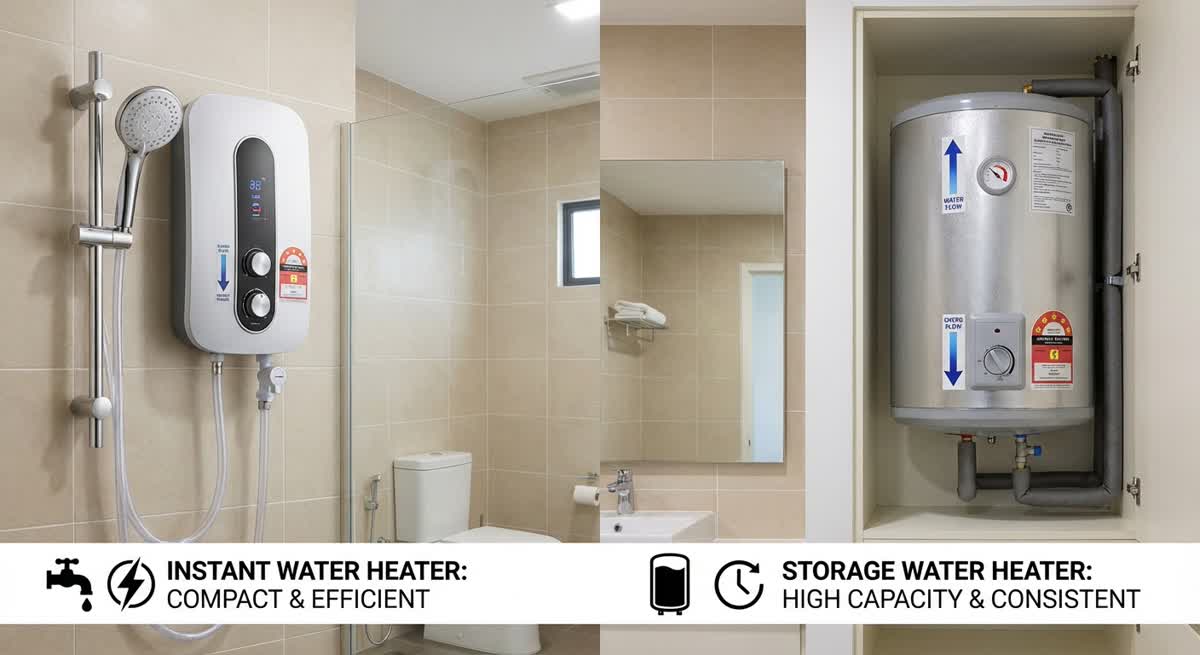
If you've ever stood in a hardware store staring at rows of water heaters, you're not alone. Choosing between an instant water heater and a storage water heater is one of the most common dilemmas Malaysian homeowners face—especially when renovating a bathroom or replacing a faulty unit. Both types get the job done, but they work in very different ways, and the right choice depends on your household's needs, budget, and bathroom setup.
In this guide, we'll break down the key differences between instant and storage water heaters so you can make a confident decision for your home. Whether you live in a high-rise condo in KL, a terrace house in Petaling Jaya, or a semi-D in Shah Alam, understanding how each type works will save you money and headaches down the road. Whichever type you choose, regular servicing is essential — read about how often to service your water heater.
How Instant Water Heaters Work
Quick Definition
An instant (or tankless) water heater heats water on demand the moment you turn on the tap. There's no storage tank—cold water flows through a powerful heating element and comes out hot within seconds.
Instant water heaters are by far the most popular choice in Malaysian homes, and it's easy to see why. They're compact, affordable, and straightforward to install. You'll typically find them mounted directly next to the shower head in the bathroom. Brands like Panasonic, Joven, and Alpha dominate the local market, with prices starting from around RM150 for basic models up to RM800 or more for units with built-in pumps and digital temperature controls.
Because they only heat water when you need it, instant heaters don't consume electricity while sitting idle. This makes them energy-efficient in a straightforward way—you only pay for the hot water you actually use.
Advantages of Instant Water Heaters
- Compact size: Most units are no larger than a small briefcase, making them ideal for tight Malaysian bathrooms
- Lower upfront cost: Entry-level models start from RM150–RM300
- No standby energy loss: Water is heated only when the tap is turned on
- Easy installation: Wall-mounted near the shower point, usually completed in under two hours
- Endless hot water: As long as the unit is running, you'll have hot water—no waiting for a tank to reheat
Disadvantages of Instant Water Heaters
- Limited flow rate: Can only supply one outlet at a time—running two showers simultaneously won't work well
- Lower water pressure: Basic models without a pump may produce weak flow, especially on higher floors
- Temperature fluctuations: Cheaper models may struggle to maintain consistent temperature
- High power draw: They typically need a dedicated 30A circuit, drawing between 3,500W to 6,000W
How Storage Water Heaters Work
Quick Definition
A storage water heater has an insulated tank that holds and heats a fixed volume of water (usually 15 to 50 litres for residential use). The water is heated in advance and kept warm until you're ready to use it.
Storage water heaters are less common in Malaysian homes compared to instant units, but they're gaining popularity—particularly in condominiums, larger families, and homes where multiple hot water outlets are needed. The tank is typically installed in a concealed space like a ceiling void, utility room, or bathroom cabinet.
These units heat water to a set temperature (usually around 60°C–75°C) and maintain it using insulation and a thermostat. When hot water is drawn from the tank, cold water flows in to replace it and the heating element kicks in again. Popular brands in Malaysia include Ariston, Rheem, Joven, and Alpha, with prices ranging from RM400 to RM2,000 depending on capacity and features.
Advantages of Storage Water Heaters
- Consistent water pressure: Delivers strong, steady flow without needing a separate booster pump
- Multiple outlets: A single unit can supply hot water to the shower, basin, and even the kitchen sink simultaneously
- Stable temperature: Pre-heated water means no temperature fluctuations mid-shower
- Lower wattage: Typically draws only 1,500W–3,000W since it heats water gradually over time
- Works well in high-rise buildings: Natural gravity-fed pressure from a ceiling-mounted tank
Disadvantages of Storage Water Heaters
- Larger physical size: The tank requires dedicated installation space
- Higher upfront cost: Units plus installation typically run RM800–RM2,500
- Standby energy loss: The tank uses electricity to keep water hot even when you're not using it
- Limited hot water supply: Once the tank is emptied, you'll need to wait 20–45 minutes for it to reheat
- More complex installation: Requires proper mounting, plumbing connections, and sometimes ceiling work
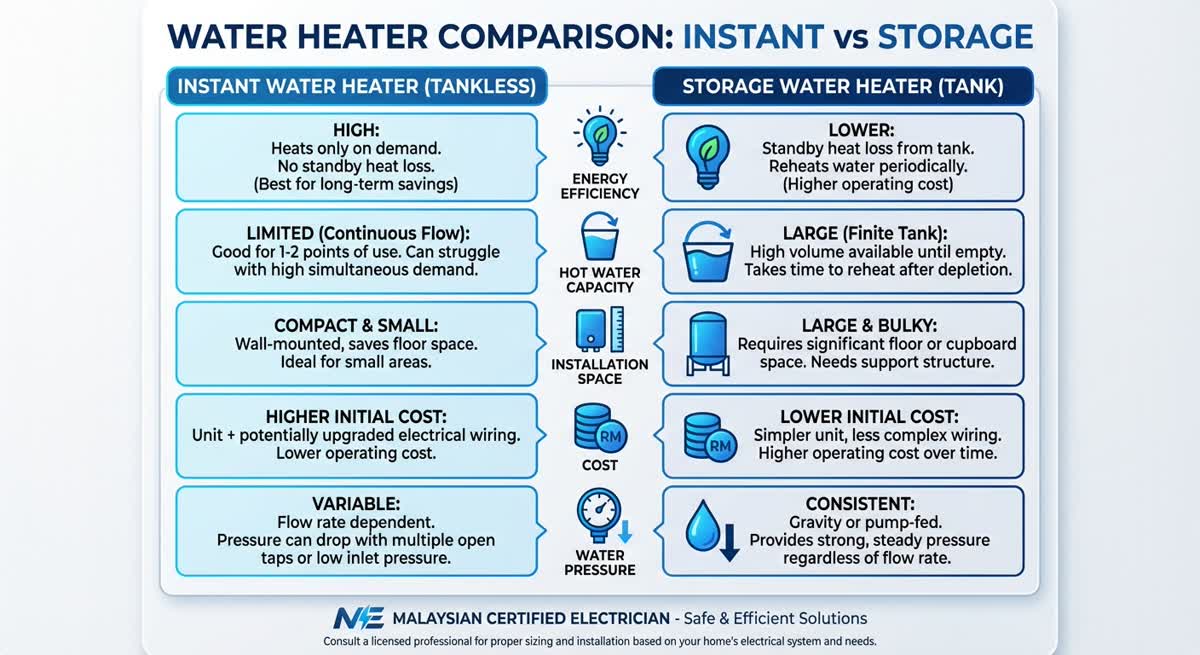
Head-to-Head Comparison: Instant vs Storage Water Heater
Let's put these two types side by side on the factors that matter most to Malaysian homeowners:
Cost
Instant heaters win on upfront cost. A decent unit with a pump costs around RM300–RM500, and installation is typically RM100–RM200. Storage heaters cost more initially—expect to pay RM800–RM2,500 including installation, depending on tank size and mounting location. However, if you factor in the cost of installing separate instant heaters for multiple bathrooms, a single storage unit may actually work out cheaper.
Energy Efficiency
This one's a bit nuanced. Instant heaters don't waste energy keeping water hot when you're asleep or at work. But they draw massive power during use (up to 6,000W). Storage heaters use less power at any given moment but consume energy around the clock to maintain tank temperature. For a typical Malaysian household, the difference in your TNB bill is usually marginal—around RM10–RM30 per month either way.
Space Requirements
In a compact Malaysian condo bathroom, space is premium. Instant heaters are the clear winner here—they mount flat on the wall and take up almost no room. Storage tanks need a dedicated spot, whether that's above the ceiling, in a utility cupboard, or on a reinforced wall bracket. If your bathroom is tight on space, an instant heater is the practical choice.
Water Pressure and Flow
Storage heaters generally deliver better water pressure, especially in gravity-fed systems common in Malaysian apartments and condos. The elevated tank creates natural pressure. Instant heaters often need a built-in or external pump to achieve acceptable shower pressure, which adds to the cost and can be noisy.
Number of Hot Water Points
If you only need hot water at one shower, an instant heater is perfectly fine. But if you want hot water at the shower, wash basin, and kitchen sink—or if two family members shower at the same time—a storage heater is the better option. Running multiple instant heaters for different outlets adds up quickly in terms of both cost and circuit requirements.
💡 Pro Tip from Our Team
Before choosing a water heater, check your home's electrical capacity. Instant heaters need a dedicated 30A circuit each, while storage heaters typically run on a standard 15A or 20A circuit. If your DB box is already near capacity, a storage heater may be the smarter choice. Not sure about your wiring? A quick electrical safety inspection can help you find out.
Which Type Is Best for Your Malaysian Home?
Choose an Instant Water Heater If:
- You only need hot water at one or two shower points
- Your bathroom space is limited
- You're on a tighter budget
- You prefer a quick, simple installation
- You live alone or with a small household
Choose a Storage Water Heater If:
- You want hot water at multiple outlets (shower, basin, kitchen)
- Your family is larger and people shower back-to-back
- You prefer strong, consistent water pressure without a pump
- You're building or renovating and can plan the plumbing layout
- You live in a high-rise condo where water pressure can be inconsistent
Signs Your Current Water Heater Needs Replacing
Whether you currently have an instant or storage heater, there are telltale signs it's time for a replacement. Inconsistent water temperature, strange noises, visible rust or corrosion, water leaks around the unit, or a heater that's more than 8–10 years old are all red flags. If you're noticing any of these issues, have a look at our guide on water heater repair warning signs to know when repair makes sense and when replacement is the better call.
Installation Matters More Than You Think
Regardless of which type you choose, proper installation is critical. A poorly installed water heater can lead to electrical hazards, water damage, or simply poor performance. Both types require correct wiring (with proper circuit breaker sizing), secure mounting, and leak-free plumbing connections.
For storage heaters in particular, the installation is more involved—the tank is heavy when full (a 25-litre tank weighs over 30 kg with water), so wall mounting needs to be into solid masonry or properly reinforced. Ceiling-void installations require adequate access for future maintenance.
This is why we always recommend professional water heater installation rather than DIY attempts. A licensed electrician ensures your unit is wired safely, your circuit breaker is correctly rated, and everything meets Malaysian electrical safety standards.
Frequently Asked Questions
Can I use an instant water heater for my kitchen sink?
Yes, there are compact instant heaters designed specifically for kitchen use. However, you'll need a separate unit and dedicated circuit for the kitchen. Alternatively, a centrally located storage heater can supply both your bathroom and kitchen from a single unit.
How long does a storage water heater take to heat up?
A typical 25-litre storage heater takes about 20–30 minutes to heat water from room temperature to around 65°C. Larger tanks (40–50 litres) may take 30–45 minutes. Most homeowners set a timer so the water is hot before their usual shower time.
Do instant water heaters work well on high floors?
Basic instant heaters without a pump may produce weak water flow on higher floors due to low incoming water pressure. Models with a built-in booster pump (typically RM400–RM700) solve this problem. Storage heaters installed above the shower naturally provide gravity-fed pressure.
Which type is safer?
Both types are safe when properly installed with the correct circuit breaker, earth leakage protection (ELCB/RCCB), and grounding. Storage heaters have an additional safety consideration—the pressure relief valve must be functioning to prevent over-pressurisation. Professional installation ensures all safety requirements are met.
How much does it cost to run a water heater per month in Malaysia?
For an instant heater used 15 minutes daily, expect around RM25–RM45 per month on your TNB bill. A storage heater with a 25-litre tank typically adds RM30–RM50 monthly, depending on your usage pattern and insulation quality. The difference is usually minimal for most households.
Conclusion
The instant vs storage water heater debate doesn't have a one-size-fits-all answer. For most single-bathroom setups in Malaysian apartments and smaller homes, an instant heater is the practical, budget-friendly choice. For larger households, multi-bathroom homes, or anyone who values strong water pressure and the convenience of hot water at every tap, a storage heater is well worth the investment.
What matters most is that whichever type you choose, it's installed correctly and safely. A properly installed water heater—whether instant or storage—will give you years of reliable hot showers without worry. And in Malaysia's tropical climate, even a quick warm rinse at the end of a long day makes all the difference.