Project Overview
- Property Type: Pre-War Shophouse (Ground Floor)
- Location: Old Klang Road, Kuala Lumpur
- Project Duration: 3 Days
- Issue: Outdated Wiring Unable to Support Commercial Kitchen Equipment
- Warranty: 12 Months Parts & Labour
The Problem: Old Wiring Meeting New Demands
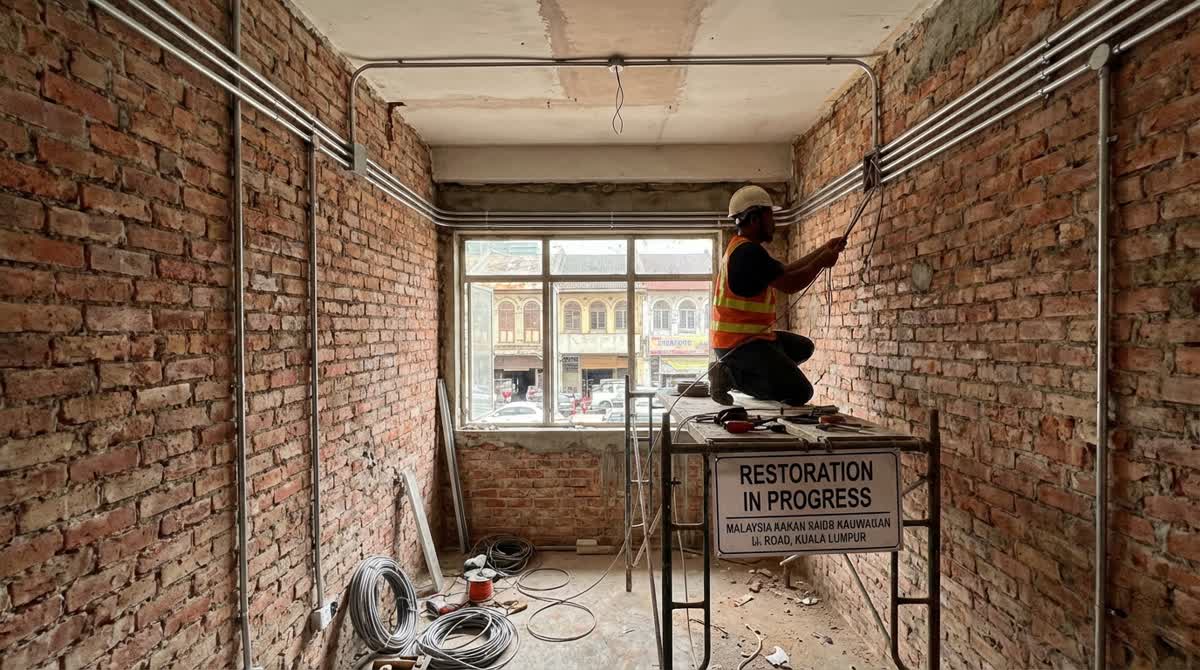
Mr. Lee had recently taken over a pre-war shophouse along Old Klang Road with plans to convert the ground floor into a small restaurant kitchen. The shophouse, built in the 1970s, still had its original wiring — rubber-insulated cables that were well past their lifespan, running through surface-mounted wooden casing and capping that had turned brittle with age.
When his contractor tried to connect the commercial kitchen equipment — a three-phase induction range, commercial exhaust hood, chest freezer, and multiple countertop appliances — the existing electrical system simply couldn't cope. The old 60A single-phase supply was nowhere near sufficient, and the ancient rewirable fuse board tripped constantly under even moderate load.
"Every time we switched on more than two appliances, the whole place went dark," Mr. Lee told us. "My contractor said we need to redo all the kitchen wiring before we can even think about opening."
Our Assessment
Our team visited the shophouse for a thorough assessment. What we found was typical of pre-war shophouses along Old Klang Road and similar areas in Kuala Lumpur — decades-old infrastructure that was never designed for modern commercial use.
Key findings:
- Rubber-insulated cabling: The original wiring used rubber insulation — a material that becomes brittle and crumbles after 30+ years, exposing live conductors. Several sections were already showing bare copper where the insulation had cracked away.
- Undersized supply: The existing 60A single-phase supply was adequate for a residential shophouse but completely insufficient for commercial kitchen equipment, which required a three-phase supply.
- No earth leakage protection: The old rewirable fuse board had no ELCB/RCCB — a serious safety concern, especially in a wet kitchen environment where water and electricity are in close proximity.
- Wooden casing and capping: The old surface-mounted wiring used wooden channels — a genuine fire hazard, particularly in a kitchen where heat and grease are constant.
- No dedicated circuits: Everything was running off two circuits. A commercial kitchen needs dedicated circuits for each major piece of equipment.
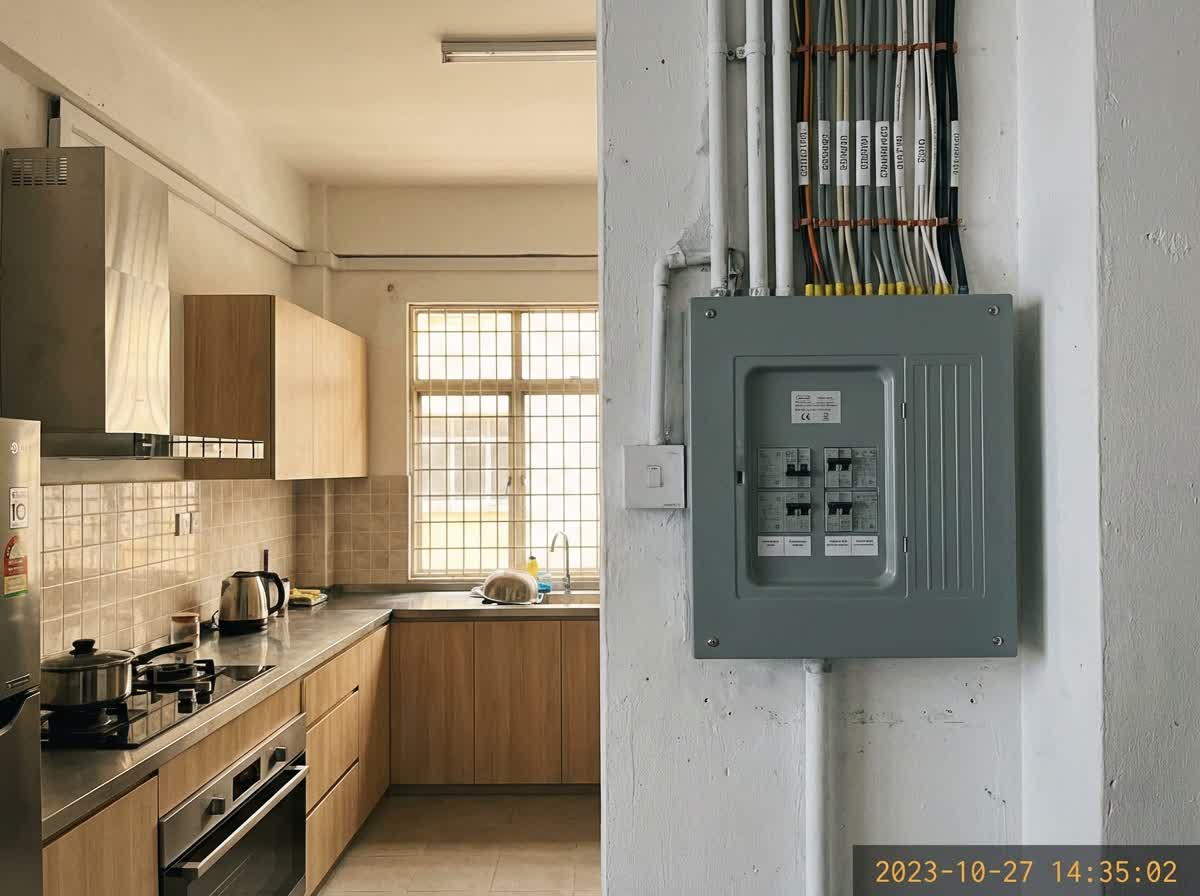
The completed installation — new three-phase DB board with dedicated circuits for each piece of kitchen equipment.
The Rewiring Work
Day 1: Supply Upgrade and DB Board Installation
The first priority was upgrading the electrical supply. We coordinated with TNB (Tenaga Nasional Berhad) to upgrade the shophouse from a 60A single-phase supply to a 100A three-phase supply. This involved running new mains cables from the TNB meter to a brand-new three-phase distribution board we installed in a protected area near the back entrance.
The new DB board featured:
- 100A three-phase main switch
- RCCB (residual current circuit breaker) for earth leakage protection on all circuits
- Individual MCBs for each dedicated circuit
- Surge protection device (SPD) to protect sensitive equipment
- Proper labelling for easy identification during emergencies
Day 2: Cable Installation
With the old wiring completely stripped out, we ran new PVC-insulated copper cables throughout the kitchen. Given the shophouse's thick masonry walls, we used a combination of concealed wiring (chased into walls where possible) and surface-mounted PVC conduit in areas where wall chasing wasn't practical.
The kitchen received the following dedicated circuits:
- Three-phase induction range: 6mm² cable on a 32A three-phase MCB
- Commercial exhaust hood: 2.5mm² cable on a dedicated 20A MCB
- Chest freezer: 2.5mm² cable on a dedicated 16A MCB
- Countertop appliance ring: 4mm² cable on a 20A MCB with multiple 13A socket outlets
- Lighting circuit: 1.5mm² cable on a 10A MCB — we installed LED panels for bright, energy-efficient kitchen lighting
- Water heater: 4mm² cable on a dedicated 20A MCB with isolator switch
- Spare circuits: Two spare MCB positions for future equipment
All cables were rated for the specific load of each appliance, with appropriate derating applied for the ambient temperature in a commercial kitchen — which can exceed 40°C during peak cooking hours.
⚡ Shophouse Wiring Challenge
Pre-war shophouses have thick masonry walls that are difficult to chase. Unlike modern brick-and-plaster construction, these walls are often solid brick or even stone. We use specialised diamond-tipped channel cutters and plan cable routes carefully to minimise structural impact while keeping the installation neat and compliant.
Day 3: Termination, Testing, and Commissioning
On the final day, we terminated all cables at the DB board and socket outlets, installed isolator switches for major appliances, and conducted comprehensive testing:
- Insulation resistance testing: All circuits tested above 2MΩ (megaohms) — well above the minimum 1MΩ requirement
- Earth continuity testing: Verified that all exposed metalwork and equipment enclosures were properly earthed
- RCCB trip testing: Confirmed the RCCB tripped within 30 milliseconds at 30mA — the standard required for personal protection
- Load testing: Ran all kitchen equipment simultaneously to verify no MCB trips or voltage drops under full load
- Thermal imaging: Used a thermal camera to check all connections and cables under load for any hotspots
Results
Before
50-year-old rubber wiring on wooden casing. 60A single-phase supply. No earth leakage protection. Constant tripping under basic load. Unable to run commercial equipment.
After
Brand new PVC copper wiring in conduit. 100A three-phase supply. Full RCCB protection. Dedicated circuits for every major appliance. Ready for commercial kitchen operation.
✅ Project Results
- Completion Time: 3 days
- Supply Upgrade: 60A single-phase → 100A three-phase
- Circuits Installed: 8 dedicated circuits (including 2 spare)
- Safety: Full RCCB protection, surge protection, proper earthing
- Compliance: Fully compliant with MS IEC 60364 and local authority requirements
- Warranty: 12 months on all parts and labour
Client Feedback
"The old wiring was honestly scary — bare wires everywhere once they opened up the walls. Prime Electrician did a really professional job. Everything is neatly installed, properly labelled, and most importantly, we can now run all our kitchen equipment without any issues. They even left spare circuits for when we add more equipment next year. Very happy with the work."
— Mr. Lee, Business Owner, Old Klang Road, KL
Lessons for Shophouse Owners in KL
Old Klang Road, Jalan Ipoh, Pudu, and Petaling Street — these historic areas of Kuala Lumpur are full of pre-war and post-war shophouses that are being converted into restaurants, cafes, and retail spaces. If you're renovating a shophouse for commercial use, here are the key electrical considerations:
- Budget for a complete rewire: Don't try to save money by keeping old wiring. Rubber-insulated cables from the 1960s and 1970s are a genuine fire hazard and will not pass inspection for a commercial premise.
- Upgrade your supply early: TNB supply upgrades can take 2-4 weeks to process. Apply early in your renovation timeline so you're not waiting on TNB when everything else is ready.
- Plan for commercial loads: A commercial kitchen draws significantly more power than a residential one. Work with your electrician to calculate the total load and size your supply accordingly.
- Get proper certification: Commercial premises need a Form G (completion and compliance form) signed by a licensed electrical contractor. This is required for your business license application.
Whether you're converting a shophouse kitchen, upgrading an old home, or setting up a new commercial space, getting the electrical infrastructure right from the start saves money, prevents downtime, and keeps everyone safe.