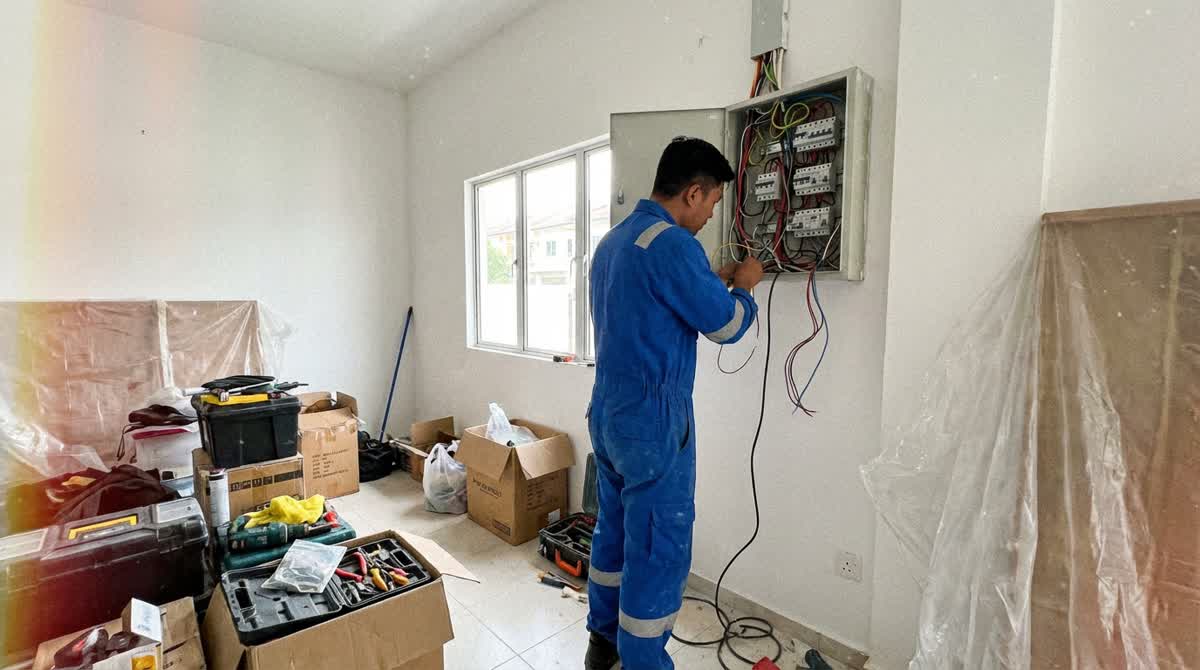
Renovating your home is exciting—new kitchen layouts, open-plan living spaces, maybe even an extra room upstairs. But before your contractor starts swinging the sledgehammer, there's one critical step that many Malaysian homeowners overlook: preparing your home's electrical system.
Poor electrical planning before a renovation can lead to costly rework, safety hazards, and frustrating delays. We've seen homeowners in Petaling Jaya spend thousands of ringgit tearing out freshly plastered walls just to add a forgotten power point. Don't let that be you.
In this guide, we'll walk you through everything you need to know about getting your home's electrical system renovation-ready—from initial assessments to coordinating with TNB and your renovation contractor.
1. Start with a Full Electrical Safety Inspection
Why Inspect Before Renovating?
An electrical inspection reveals hidden problems—degraded wiring, overloaded circuits, outdated DB boxes—that are far easier (and cheaper) to fix during renovation than after. Think of it as an X-ray before surgery.
Before any renovation work begins, have a licensed electrician conduct a thorough electrical safety inspection of your home. This inspection should cover:
- Wiring condition: Check for degraded insulation, aluminium wiring (common in older Malaysian homes built before the 1990s), or undersized cables that can't handle modern electrical loads
- DB box assessment: Evaluate whether your current distribution board has enough capacity for your renovation plans, or if it needs upgrading from older rewireable fuses to modern MCBs and RCCBs
- Earthing system: Verify that your home's earthing is up to current MS IEC standards—a critical safety requirement that's often inadequate in older properties
- Circuit mapping: Document which circuits serve which areas, so your renovation team knows exactly what they're working around
- Load calculation: Assess your current electrical consumption and project future needs based on your renovation plans
This inspection typically costs between RM200 and RM500 depending on the size of your home, but it can save you thousands in avoided problems down the road.
2. Plan Your Electrical Layout Before Construction Begins
This is where most renovation electrical problems originate—insufficient planning. Once your renovation design is finalised, sit down with your electrician and map out every single electrical point you'll need:
Power Points and Outlets
- Kitchen: Plan for dedicated circuits for heavy appliances—your oven, induction hob, dishwasher, and water heater each need their own circuit. Don't forget countertop outlets for the rice cooker, air fryer, and blender
- Living areas: Consider where your TV, sound system, and router will go. Plan USB charging outlets near seating areas
- Bedrooms: Outlets on both sides of the bed, plus dedicated points for air-conditioning units
- Home office: If you're working from home (and many Malaysians are post-pandemic), plan for multiple outlets, network points, and a dedicated circuit to prevent tripping during video calls
Lighting Design
- Decide on lighting types early: recessed downlights, pendant lights, cove lighting, or track lighting each have different wiring requirements
- Plan dimmer switch locations for living rooms and bedrooms
- Consider motion sensor lights for bathrooms, storerooms, and car porches
- Don't forget under-cabinet lighting in the kitchen and wardrobe lights in bedrooms
💡 Pro Tip: The "One More" Rule
Whatever number of power points you think you need, add one more per wall. It costs very little during renovation but saves a fortune if you need to add them later. A single 13A socket point added during renovation costs around RM80-120, but adding one after renovation (with hacking and replastering) can cost RM300-500.
3. Decide Whether You Need Full or Partial Rewiring
One of the biggest decisions during a renovation is whether to rewire your home entirely or just update specific sections. Here's how to decide:
Full Rewiring Is Recommended When:
Your home is more than 25-30 years old, uses aluminium wiring, has a fuse-type DB box, or you're doing a major structural renovation that opens up most walls anyway. Full rewiring for a typical Malaysian terrace house costs between RM5,000 and RM15,000 depending on size and complexity.
Partial Rewiring May Suffice When:
Your home's existing wiring is in good condition (copper, properly insulated), your DB box is modern, and you're only renovating specific areas like the kitchen or bathrooms. Partial rewiring for a kitchen renovation typically costs RM1,500 to RM4,000.
Your electrician can advise based on the inspection results, but as a general rule: if you're opening up walls anyway, it's almost always worth rewiring those sections. The labour cost of running new cables is minimal when walls are already exposed—it's the hacking and replastering that's expensive.
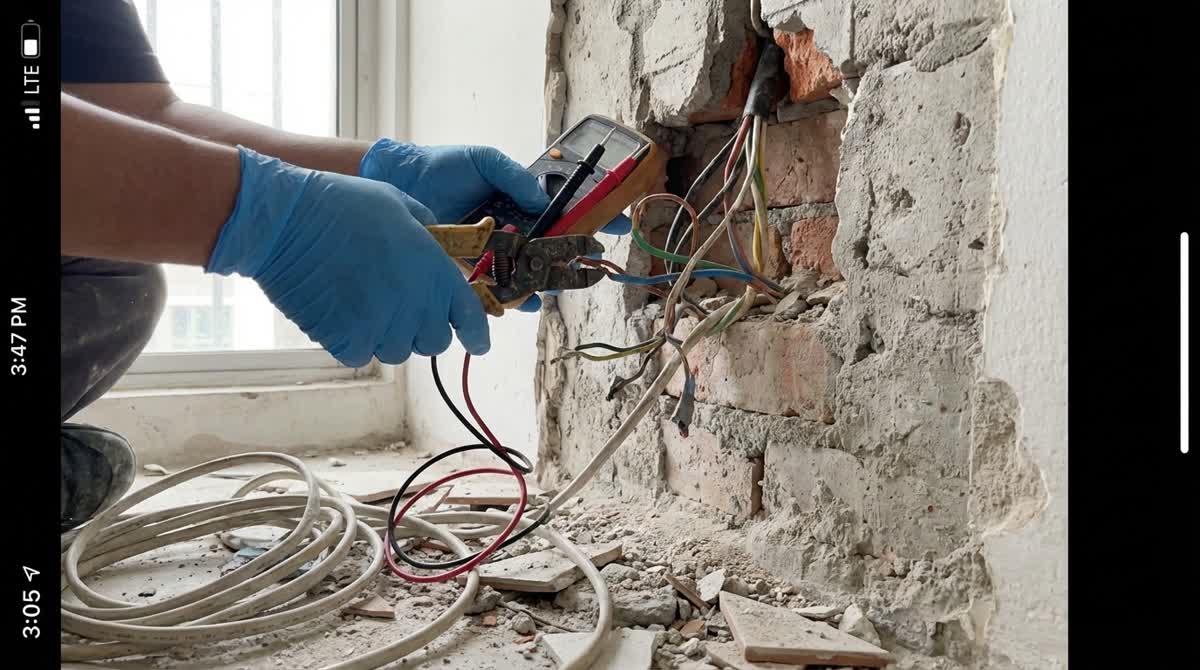
4. Upgrade Your DB Box and Electrical Capacity
Your distribution board (DB box) is the heart of your home's electrical system. If you're renovating, this is the perfect time to upgrade it. Here's what to consider:
- Capacity: A typical older Malaysian home has a 60A single-phase supply. Modern homes with air-conditioning in every room, electric water heaters, and induction hobs may need a 100A supply or even a three-phase upgrade
- MCB protection: Replace old rewireable fuses with modern miniature circuit breakers (MCBs) that provide faster, more reliable overcurrent protection
- RCCB/ELCB installation: Residual current devices are now mandatory under Malaysian electrical regulations. They detect earth leakage and cut power in milliseconds—potentially saving lives
- Surge protection: Consider adding surge protection devices (SPDs) to protect expensive electronics from voltage spikes, which are common during Malaysian thunderstorm season
- Future expansion: Choose a DB box with spare ways for future additions. A 18-way or 24-way board gives you room to grow
A full DB box upgrade typically costs between RM1,200 and RM3,000 including the board, MCBs, RCCB, and installation labour.
5. Coordinate Between Your Electrician and Renovation Contractor
This is crucial, and it's where many renovations go wrong. Electrical work needs to happen at specific stages of the renovation process:
Phase 1: First Fix (Before Plastering)
- All wiring is run through walls, ceilings, and floors
- Switch boxes and outlet boxes are installed at the correct heights
- Conduit is laid for future cable runs
- DB box is mounted and main cables connected
Phase 2: Second Fix (After Plastering, Before Painting)
- Switches, outlets, and faceplates are installed
- Light fixtures are mounted and connected
- All circuits are tested and labelled
- Final connections to appliances are completed
Make sure your renovation contractor and electrician communicate directly. We've seen cases where contractors plaster over conduit openings or install ceiling boards before electrical first fix is complete, leading to costly rework.
💡 Scheduling Tip
Book your electrician at least 2-3 weeks before the renovation starts. Good licensed electricians in the Klang Valley are often booked solid, and you don't want your renovation stalled waiting for electrical first fix.
6. Handle TNB Requirements Early
If your renovation requires upgrading your electrical supply—from single-phase to three-phase, or increasing your supply capacity—you'll need to coordinate with Tenaga Nasional Berhad (TNB). This process can take 4-8 weeks, so start early:
- Application: Submit a supply upgrade application through TNB's portal or visit your nearest TNB branch with your renovation plans
- Inspection: TNB will inspect your premises and determine the feasibility of the upgrade
- Meter upgrade: You may need a new meter box and service cable, which TNB will install
- Costs: TNB supply upgrades typically cost between RM500 and RM2,000 depending on the type of upgrade required
Your electrician can help coordinate the TNB application and ensure all paperwork is in order. Don't leave this to the last minute—a delayed TNB upgrade can hold up your entire renovation timeline.
7. Plan for Temporary Power During Renovation
During renovation, your home's power will likely be disrupted at various stages. Plan ahead:
- Temporary power supply: Discuss with your electrician how to maintain power to essential areas (fridge, security system, internet router) during the electrical work phases
- Generator backup: For major renovations where power will be cut for extended periods, your contractor may need to arrange a temporary generator
- Safety during construction: Ensure all temporary wiring used during renovation meets safety standards. Exposed cables and wet conditions are a dangerous combination
8. Don't Forget These Often-Overlooked Electrical Items
In the excitement of choosing tiles and kitchen cabinets, these electrical items often get forgotten until it's too late:
- Electric gate and autogate motor: Needs a dedicated power supply and sometimes a separate circuit
- CCTV and security system wiring: Run cables during first fix, even if you're not installing cameras immediately
- Water heater circuits: Each instant water heater needs its own dedicated 20A or 30A circuit
- Aircon points: Plan for both the indoor and outdoor unit power supply, including the correct isolator switches
- EV charger preparation: If you're considering an electric vehicle in the future, run a dedicated cable from the DB box to your car porch now. Adding one later is significantly more expensive
- Network cabling: While not strictly electrical, running CAT6 Ethernet cables during renovation gives you reliable wired internet throughout the house
- Ceiling fan points: These need reinforced mounting and often a separate switch—plan locations carefully
9. Budget Wisely for Electrical Renovation Work
Electrical work typically accounts for 10-15% of your total renovation budget. Here's a rough guide for Malaysian homes:
- Basic electrical renovation (new points, DB upgrade, partial rewiring): RM3,000-8,000
- Comprehensive electrical wiring (full rewiring, new DB, lighting design): RM8,000-20,000
- Premium electrical renovation (smart home integration, premium fixtures, three-phase upgrade): RM15,000-35,000+
Always get at least three quotations and ensure they include detailed breakdowns. A proper quotation should list every switch, outlet, circuit, and cable type—not just a lump sum figure.
10. Ensure Compliance and Get Proper Documentation
After renovation, make sure your electrical work is properly documented and compliant:
- Wiring completion certificate: Your electrician should provide a certificate confirming all work meets MS IEC standards
- Updated circuit diagram: Get a labelled diagram of your new DB box showing all circuits and their ratings
- Warranty documentation: Ensure you have written warranties for both materials and workmanship
- TNB compliance: If supply was upgraded, confirm TNB has approved and documented the new installation
Frequently Asked Questions
How long does electrical renovation work take?
For a typical Malaysian terrace house, electrical first fix takes 2-3 days, with second fix requiring another 1-2 days after plastering. A complete rewiring of a double-storey terrace usually takes 4-5 working days in total. However, this doesn't include waiting time for plastering between first and second fix.
Can I do electrical renovation work myself?
No. Under Malaysian law (Electricity Supply Act 1990), all electrical installation work must be carried out by a licensed electrical contractor registered with the Energy Commission (Suruhanjaya Tenaga). DIY electrical work is not only illegal but extremely dangerous. Faulty wiring is one of the leading causes of house fires in Malaysia.
Should I upgrade to three-phase supply during renovation?
If your total connected load exceeds 60A (common in homes with multiple air-conditioners, electric water heaters, and an induction hob), upgrading to three-phase is advisable. Your electrician can perform a load calculation to determine if this is necessary. Three-phase supply provides more balanced power distribution and handles heavy loads more efficiently.
What's the difference between rewiring and adding new points?
Rewiring means replacing existing cables with new ones—typically done when old wiring is degraded or undersized. Adding new points means extending circuits to provide additional outlets or switches in new locations. During renovation, you may need both: rewiring old sections and adding new points for the renovated areas.
How do I know if my home's wiring needs replacing?
Warning signs include frequent circuit breaker tripping, flickering lights, warm or discoloured outlet faceplates, a burning smell near switches, and visible cable damage. If your home is more than 25 years old and has never been rewired, an inspection is strongly recommended before renovation.
Conclusion
Preparing your home's electrical system for renovation isn't the most glamorous part of the process, but it's arguably the most important. Proper electrical planning prevents safety hazards, avoids costly rework, and ensures your renovated home can handle all the modern appliances and technology you've been dreaming of.
Start with an inspection, plan thoroughly, coordinate closely between your electrician and contractor, and don't cut corners on safety. Your future self—enjoying a beautifully renovated home with reliable, safe electrical systems—will thank you.