If you've ever walked into a lighting shop or browsed online for ceiling lights in Malaysia, you've probably come across two terms that keep popping up: downlights and surface lights. They're both ceiling-mounted, both widely used in Malaysian homes, and both available in a dizzying range of shapes and sizes. So what's the actual difference—and which one should you pick for your home?
In this guide, we'll break down the key differences between downlights (also called recessed lights) and surface-mounted lights. We'll cover how each type is installed, where they work best, the costs involved, and the practical considerations specific to Malaysian housing types—from high-rise condos to double-storey terrace houses.
Quick Overview: Downlights vs Surface Lights
Before we get into the details, here's the simplest way to think about it:
Downlights (Recessed Lights)
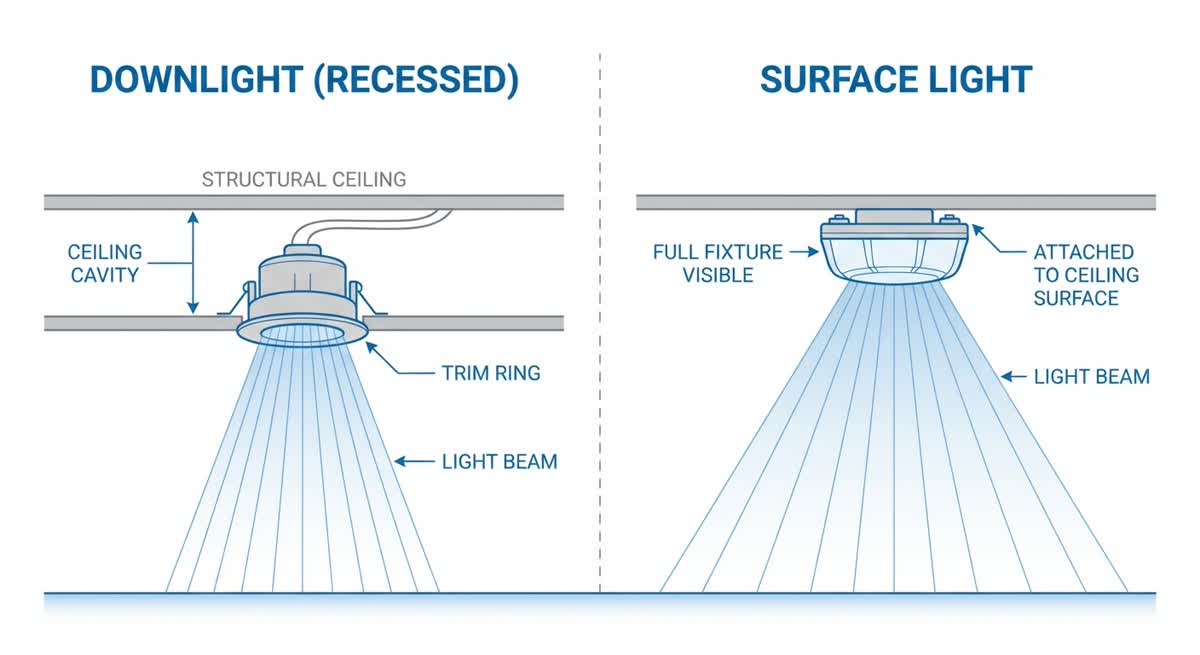
Installed inside the ceiling, sitting flush with the surface. Only the light-emitting face is visible. The housing and wiring are hidden above the ceiling. These require a false ceiling or plaster ceiling with enough clearance behind it.
Surface Lights (Surface-Mounted Lights)
Mounted directly onto the ceiling surface. The entire fixture is visible and protrudes slightly from the ceiling. These can be installed on virtually any ceiling type—concrete, plaster, or otherwise—without requiring a cavity behind them.
That's the core difference. One goes inside the ceiling, the other sits on top of it. But the implications of this simple distinction are far-reaching when it comes to aesthetics, installation, cost, and suitability for different spaces.
How Downlights Work
Downlights, sometimes called recessed lights or pot lights, are designed to be installed into a hole cut into the ceiling. The fixture body sits above the ceiling plane, and only a trim ring and the light source itself are visible from below. The result is a clean, minimalist look where the light appears to come from the ceiling itself rather than from a visible fixture.
Modern LED downlights in Malaysia are typically round, ranging from 7 cm to 20 cm in diameter, and come in various wattages from 5W to 24W. They produce a focused beam of light directed downward, which is why they're called "downlights." The beam angle usually ranges from 60° to 120°, affecting how wide the light spreads.
Requirements for Downlight Installation
- False ceiling or plaster ceiling: You need at least 10-15 cm of clearance above the visible ceiling to accommodate the fixture housing
- Ceiling cut-out: A circular hole must be cut precisely to match the fixture size
- Wiring access: Electrical wiring needs to be run above the false ceiling to each fixture location
- Heat dissipation space: LED downlights generate less heat than older halogen types, but still need some air circulation above
In Malaysia, most condominiums and modern terrace houses come with plaster ceilings in at least the living room and master bedroom, making downlight installation straightforward. Older properties with only bare concrete ceilings will need a false ceiling installed first, which adds to the cost.
How Surface Lights Work
Surface-mounted lights attach directly to the ceiling via a mounting plate or bracket. The entire light fixture is visible and typically protrudes 3 to 10 cm from the ceiling surface. They come in a huge variety of styles—round, square, rectangular, decorative, and even track-mounted options.
Because they don't need a cavity behind them, surface lights are extremely versatile. They can go on concrete ceilings, plaster ceilings, wooden beams, or virtually any solid overhead surface. This makes them the go-to choice when a false ceiling isn't available or practical.
Common Types of Surface Lights
- Surface-mounted downlights: Round or square fixtures that project light downward, similar to recessed downlights but mounted on the surface
- LED panel lights: Flat, slim panels (often square or rectangular) that provide even, diffused lighting—very popular in Malaysian kitchens and offices
- Oyster lights / ceiling lights: Decorative round fixtures with a diffuser, common in bedrooms and hallways
- Track lights: Adjustable spotlights mounted on a track, popular for highlighting artwork or specific areas
Key Differences at a Glance
1. Aesthetics and Visual Impact
Downlights win on minimalism. Because they're flush with the ceiling, they create a clean, uncluttered look. If you're going for a modern, sleek interior—the kind you see in show units at Mont Kiara or Bangsar South condos—downlights are typically the way to go. They make ceilings appear higher and rooms feel more spacious.
Surface lights are more visually present. Depending on the design, they can be a feature element in the room (think decorative oyster lights or statement track lighting) or simply functional (basic LED panels in the kitchen). Some homeowners prefer this visible presence, especially in traditional or transitional interior styles.
2. Ceiling Requirements
This is often the deciding factor for Malaysian homeowners. Downlights require a false ceiling with sufficient clearance—at least 10 cm, ideally 15 cm. If your home doesn't have one, you'll need to budget for plaster ceiling work, which typically costs RM8 to RM15 per square foot in Malaysia.
Surface lights can go on any ceiling. This makes them ideal for older apartments, rooms without plaster ceilings, car porches, storerooms, and utility areas where installing a false ceiling would be impractical or wasteful.
3. Installation Complexity and Cost
Downlight installation involves cutting holes, running concealed wiring, and ensuring proper alignment—it's more labour-intensive. Expect to pay RM50 to RM120 per point for professional lighting installation, depending on wiring complexity and ceiling access.
Surface light installation is generally simpler. The fixture mounts to the ceiling with screws, and wiring connects to the existing ceiling point. Installation costs are typically RM40 to RM80 per fixture. However, if you're adding new wiring points on a concrete ceiling, the cost increases due to the need for surface conduit or wall chasing.
4. Light Distribution
Downlights produce a focused, directional beam. This is excellent for task lighting (kitchen counters, reading nooks) and creating layered lighting effects. However, a single downlight won't illuminate an entire room—you usually need multiple units spaced evenly across the ceiling.
Surface lights, particularly panel lights and oyster lights, tend to provide broader, more diffused illumination. A single well-sized surface light can adequately light a small to medium room, which is why you'll often see one large panel light in Malaysian apartment bedrooms rather than multiple downlights.
5. Maintenance and Replacement
Both types are straightforward to maintain with modern LED technology. However, there's a practical difference: if a downlight fails, you need to reach into the ceiling cavity to disconnect and replace it. Surface lights simply unscrew from the ceiling.
For high-ceiling areas common in Malaysian double-volume living rooms, accessibility matters. Surface lights are generally easier to service because the entire fixture is accessible from below.
6. Heat Management
In Malaysia's tropical climate, heat is always a consideration. Downlights trap some heat in the ceiling cavity, which can contribute to a warmer room if you have many fixtures and poor roof insulation. This was a bigger concern with older halogen downlights (which ran very hot), but modern LED downlights produce significantly less heat.
Surface lights dissipate heat directly into the room, which is actually more efficient for the fixture itself but makes no practical difference to room temperature with LED technology.
Which Rooms Suit Which Type?
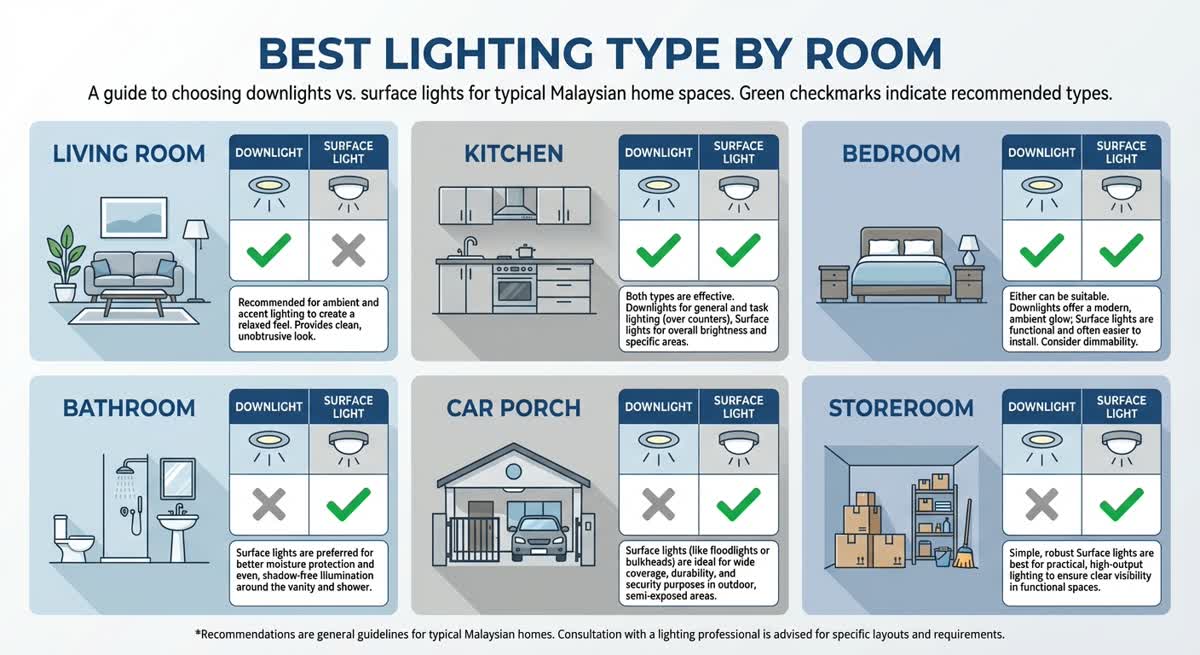
Here's a practical room-by-room guide based on typical Malaysian homes:
Living Room
Best choice: Downlights (if you have a plaster ceiling). Most modern Malaysian living rooms use 4 to 8 recessed downlights for general illumination, often supplemented with cove lighting for ambiance. If you don't have a false ceiling, a combination of surface panel lights and decorative pendants works well.
Kitchen
Best choice: Surface panel lights or downlights. Malaysian kitchens deal with grease and moisture, so easy-to-clean surface panels are practical. Downlights over the countertop provide excellent task lighting for food prep. Many homes use a combination of both.
Bedrooms
Best choice: Either works well. Downlights give a hotel-like feel. A central surface light (oyster style) provides good general illumination and is easier to install if you're on a budget. Consider what type of light switch you'll pair with your chosen fixture—dimmers work beautifully with both downlights and surface lights in bedrooms.
Bathrooms
Best choice: Surface lights with IP rating. Bathroom lighting needs to be moisture-resistant. While downlights can work in bathrooms (with IP65-rated fixtures), surface-mounted LED panels or oyster lights rated for wet areas are more common and practical in Malaysian bathrooms.
Car Porch and Outdoor Areas
Best choice: Surface lights. Most car porches have concrete ceilings without a false ceiling, making surface-mounted floodlights or weatherproof ceiling lights the natural choice.
Storerooms and Utility Areas
Best choice: Surface lights. No need for aesthetic considerations here—a simple surface-mounted LED batten or panel does the job efficiently and cheaply.
💡 Pro Tip: Mix and Match
Many Malaysian homes use a combination of both types. A common approach is downlights in the living areas and master bedroom (where aesthetics matter most), with surface lights in the kitchen, bathrooms, and utility spaces. This balances visual appeal with practical installation considerations and keeps costs reasonable.
Cost Comparison for Malaysian Homes
Here's a realistic cost breakdown based on current Malaysian market prices:
Downlights
- LED downlight fixture: RM15 to RM80 per unit (depending on brand, wattage, and features)
- Installation per point: RM50 to RM120
- False ceiling (if needed): RM8 to RM15 per sq ft
- Typical living room setup (6 downlights): RM500 to RM1,500 total
Surface Lights
- LED surface light fixture: RM30 to RM200 per unit (wide range depending on style)
- Installation per fixture: RM40 to RM80
- No false ceiling required
- Typical living room setup (1-2 surface lights): RM200 to RM600 total
As you can see, surface lights tend to be more budget-friendly overall, especially when you factor in the cost of a plaster ceiling. However, if your home already has a false ceiling (which many newer Malaysian condos and terrace houses do), the cost difference between the two is much smaller.
Energy Efficiency: Is There a Difference?
With modern LED technology, there's minimal difference in energy efficiency between downlights and surface lights of the same wattage. A 12W LED downlight and a 12W LED surface light will consume the same amount of electricity and produce roughly the same amount of light (measured in lumens).
The real energy consideration is how many fixtures you need. Since downlights typically cover a smaller area per unit, you may need more of them compared to a single large surface panel light. For example, lighting a 150 sq ft bedroom might require four 12W downlights (48W total) versus one 36W surface panel light. In this case, the surface light is actually more energy-efficient for the same level of illumination.
Making Your Decision
Choosing between downlights and surface lights ultimately comes down to three things:
- Your ceiling type: No false ceiling? Surface lights are your best bet unless you plan to install one.
- Your aesthetic preference: Want a sleek, modern look? Downlights. Want something more decorative or don't mind visible fixtures? Surface lights.
- Your budget: Surface lights are generally cheaper, especially if false ceiling work is needed. But for homes that already have plaster ceilings, the cost is comparable.
Whichever you choose, make sure you hire a qualified electrician for the installation. Improper wiring can cause flickering, overheating, or even electrical hazards—especially with recessed fixtures where wiring is hidden and harder to inspect later.
Frequently Asked Questions
Can I replace my existing surface lights with downlights?
Yes, but only if you have a false ceiling with enough clearance (at least 10 cm). If your ceiling is bare concrete, you'll need to install a plaster ceiling first. A licensed electrician can assess your ceiling and advise on the best approach.
Are downlights brighter than surface lights?
Not necessarily. Brightness depends on the wattage and lumen output, not the mounting type. A 12W downlight and a 12W surface light will produce similar brightness. However, downlights concentrate the light in a narrower beam, which can make them appear brighter directly below the fixture.
Do downlights make a room hotter?
Modern LED downlights produce very little heat compared to older halogen types. The difference in room temperature is negligible. If you're concerned about heat in your ceiling cavity, ensure there's adequate ventilation above the false ceiling.
How many downlights do I need for a room?
A general rule is one downlight per 1.5 to 2 square metres of floor space for general illumination. For a typical 12 x 12 foot Malaysian bedroom (about 13 sq m), you'd need 6 to 8 downlights. However, the exact number depends on wattage, beam angle, and desired brightness level.
Which type lasts longer?
Both LED downlights and LED surface lights typically last 25,000 to 50,000 hours—that's roughly 10 to 20 years of normal use. The lifespan depends more on the LED quality and brand than the mounting type. Stick with reputable brands like Philips, Panasonic, or Ikea for reliable longevity.
Conclusion
The difference between downlights and surface lights is fundamentally about installation method and aesthetics. Downlights sit inside the ceiling for a clean, modern look but require a false ceiling. Surface lights mount on top of the ceiling, work on any surface, and are generally simpler and cheaper to install.
Neither type is universally "better"—it depends entirely on your home's existing ceiling setup, your design preferences, and your budget. Many Malaysian homeowners find that a combination of both types, strategically placed throughout different rooms, gives the best balance of style, function, and value.
If you're still unsure which option suits your home, a quick consultation with a professional electrician can save you time and money. They'll assess your ceiling, discuss your lighting goals, and recommend the best approach for your specific situation.